Many buyers ask for a “commercial food dehydrator” when they actually need an industrial model. Others choose a larger machine too early and pay for capacity they do not use. The right choice depends on what you dry, how much you dry, how often you run the machine, and how much space and labor you can allocate.
Commercial and industrial food dehydrators are both designed for business use, but they serve different production stages. A small restaurant, farm shop, pet snack studio, or test kitchen usually has different needs from a factory, agricultural processor, or central kitchen.
This guide explains the practical differences so you can choose the right model before requesting a quotation.
1. Define Your Production Scenario First
Before comparing model sizes, describe your production scenario in simple numbers:
- What material will you dry?
- How many kilograms of wet material do you process per batch?
- How many batches do you run per day?
- Do you need continuous production or flexible small batches?
- What temperature range is required?
- How much space is available?
- Do operators need to load and unload trays frequently?
Commercial models are usually suitable when the buyer needs professional drying but still works in smaller batches. Industrial models are designed for higher capacity, heavier workloads, and more structured production planning.
2. When a Commercial Food Dehydrator Makes Sense
A commercial food dehydrator is often the right choice for restaurants, fruit shops, farms, bakeries, tea shops, pet snack brands, and small food workshops. These buyers need better capacity and stability than a home unit, but they may not need a large industrial drying system.
Commercial models are useful for:
- Dried fruit and vegetable snacks
- Beef jerky and meat snacks
- Pet treats
- Herbs, flowers, and tea ingredients
- Small-batch agricultural products
- Product testing before scaling up
UCK’s commercial food dehydrator range includes multi-layer models with stainless steel trays, touch controls, 30 to 90 degrees Celsius temperature adjustment on many models, and timer settings up to 24 hours. These features help small businesses reduce manual checking and keep production more consistent.
If your business handles different materials in moderate quantities, a commercial model gives flexibility without taking up the space or power demand of a larger industrial system.
3. When an Industrial Food Dehydrator Is the Better Fit
An industrial food dehydrator is built for higher-volume drying and longer operating schedules. It is suitable for food processing plants, agricultural cooperatives, central kitchens, larger pet food operations, and factories that need batch consistency.
Industrial buyers usually care about:
- Higher tray count
- Larger drying area
- Stronger airflow
- More stable temperature control
- Faster moisture removal
- Better durability for frequent operation
- Space efficiency per kilogram of material
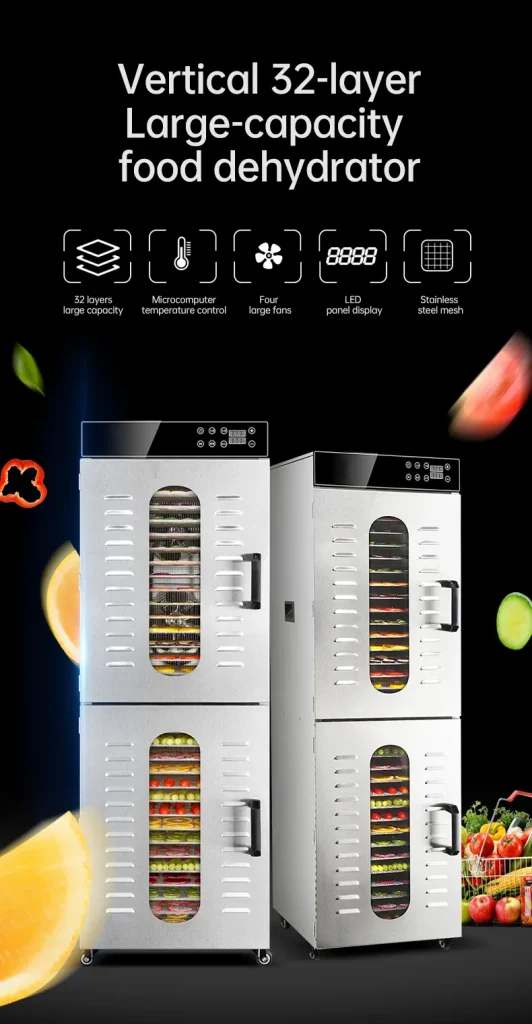
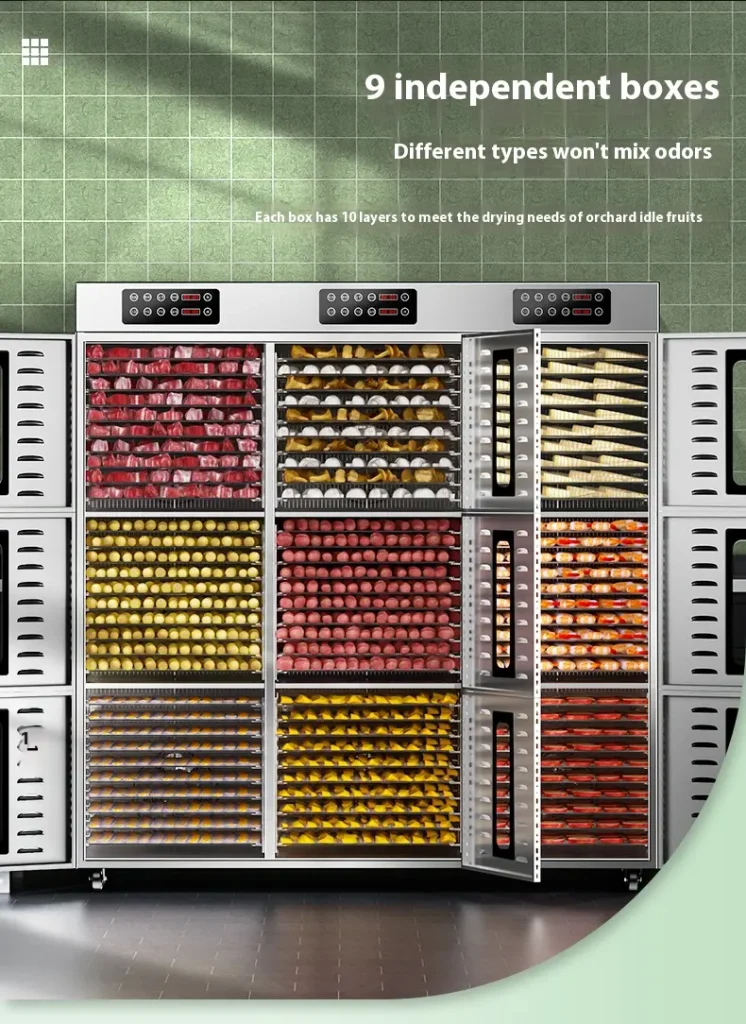
Some UCK large-capacity models include 30-layer, 32-layer, 40-layer, and higher-capacity designs. Certain rotary models are designed to improve drying uniformity by rotating trays or material during the drying process. For buyers processing large volumes, this can reduce the need for manual tray swapping.
If labor cost and batch consistency are major concerns, an industrial food dehydrator may be more economical over time, even if the initial price is higher.
4. Compare Capacity by Real Batch Load, Not Tray Count Alone
Tray count is helpful, but it is not the whole story. Two 30-layer machines can perform differently if tray size, tray spacing, fan design, power, and airflow structure are different.
When comparing models, ask for:
- Tray dimensions
- Distance between trays
- Recommended wet material loading per batch
- Power rating
- Fan quantity and airflow design
- Product size and package size
- Net weight and gross weight
For example, UCK’s selling-points documents mention food-grade 304 stainless steel trays, scientific tray spacing, multi-fan designs on some models, and wide temperature control. These details are more useful than a simple “large capacity” claim.
If you dry thin fruit slices, tray area may matter most. If you dry thicker materials, tray spacing and airflow penetration become more important.
5. Airflow and Uniform Drying Are More Important Than Appearance
A good-looking cabinet does not guarantee good drying. Uneven airflow can create batches where the top tray is too dry, the middle tray is still wet, and the bottom tray needs more time.
Commercial buyers may accept occasional tray adjustment. Industrial buyers usually cannot. The more trays you load, the more important airflow design becomes.
Useful questions include:
- Does the machine use one fan, dual fans, or multiple fans?
- Is the airflow horizontal, vertical, or rotary?
- Are there known drying blind spots?
- Can the machine handle full-load drying?
- Does the manufacturer recommend tray rotation during drying?
UCK’s product selling points mention dual-fan structures, three-fan structures, rotary drying technology, and multi-zone control on selected large models. These features should be matched to your material and production method.
6. Consider Power, Voltage, and Export Requirements
For export buyers, voltage is not a small detail. A model suitable for China may not be ready for North America, Europe, Southeast Asia, or the Middle East without changes.
UCK’s general product selling points mention wide voltage support from 110V to 240V for export needs, depending on model configuration. Buyers should confirm the correct voltage, plug, certification, and label before mass production.
For larger industrial food dehydrators, power planning is especially important. Check whether your facility can support the machine’s power demand, and confirm whether single-phase or three-phase power is required.
7. Think About Cleaning and Food Safety
In commercial and industrial drying, cleaning is part of daily operation. Trays should be removable, strong enough for repeated handling, and suitable for food contact.
Food-grade 304 stainless steel trays are a practical choice for many food drying applications because they are corrosion-resistant, washable, and suitable for contact with ingredients. UCK highlights 304 stainless steel trays on many models, along with stainless steel cabinet structures for durability.
Before choosing a model, ask:
- Can one operator remove and clean the trays easily?
- Are corners and door seals easy to wipe?
- Are trays strong enough for heavy materials?
- Are spare trays available?
- Does the machine design reduce residue buildup?
These details affect daily efficiency more than buyers often expect.
8. A Simple Selection Guide
Choose a commercial food dehydrator if:
- You run small to medium batches
- You need flexible drying for several food types
- Your space is limited
- You are testing a new product line
- You sell through restaurants, farms, shops, or online channels
Choose an industrial food dehydrator if:
- You need higher batch output
- You run the machine frequently
- You process material for wholesale or factory supply
- You need more consistent full-load drying
- Labor efficiency matters
- You want to reduce manual tray handling
The best choice is not always the biggest machine. It is the model that gives stable output at the scale your business actually needs.
FAQ
Is a commercial food dehydrator enough for a small food business?
Yes, in many cases. A commercial food dehydrator is suitable for farms, restaurants, pet snack makers, bakeries, and small workshops that need professional drying without industrial-scale capacity.
What is the main difference between commercial and industrial food dehydrators?
Commercial models focus on flexible small to medium batch drying. Industrial models focus on larger capacity, stronger airflow, longer operation, and production efficiency.
Should I choose a rotary food dehydrator?
A rotary food dehydrator can be useful when even drying is a priority and the material benefits from rotation. It is especially helpful for buyers who want to reduce manual tray adjustment.
What information should I provide for a quotation?
Provide the material type, wet loading per batch, target moisture result, voltage, plug, tray quantity, temperature range, packaging needs, and destination market.