Choosing a food dehydrator manufacturer is not only about comparing unit prices. For importers, distributors, private label brands, and equipment buyers, the real question is whether the factory can support stable production, consistent quality, and repeat orders after the first shipment.
A low quote may look attractive at the beginning. But if the supplier cannot control heating performance, tray quality, packaging, lead time, or after-sales support, the cost quickly moves into complaints, returns, delayed launches, and lost customers.
This guide explains what B2B buyers should check before working with a food dehydrator factory, especially for OEM and ODM projects.
1. Start With the Manufacturer’s Core Product Focus
Some suppliers list food dehydrators, air fryers, blenders, heaters, pet appliances, and unrelated products on the same catalog. That does not always mean they are weak, but it does mean you should ask which product line is their real manufacturing focus.
For a food dehydrator project, look for a manufacturer that understands drying performance, not just sheet metal assembly. Important details include airflow design, heating stability, tray spacing, material safety, timer accuracy, and temperature control.
For example, a serious food dehydrator manufacturer should be able to explain the difference between:
- Home food dehydrators for small-batch fruit, herbs, pet snacks, and sample drying
- Commercial food dehydrators for restaurants, farms, food workshops, and small businesses
- Industrial food dehydrators for larger batch drying and higher-capacity production
- Rotary food dehydrators for more even drying where tray rotation is useful
If the factory cannot explain which structure fits your target customer, you may end up with a product that looks acceptable but performs poorly in the market.
2. Check Factory Capacity, Not Just Product Photos
Product photos can be polished. Factory capacity is harder to fake over the long term.
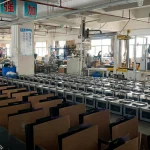
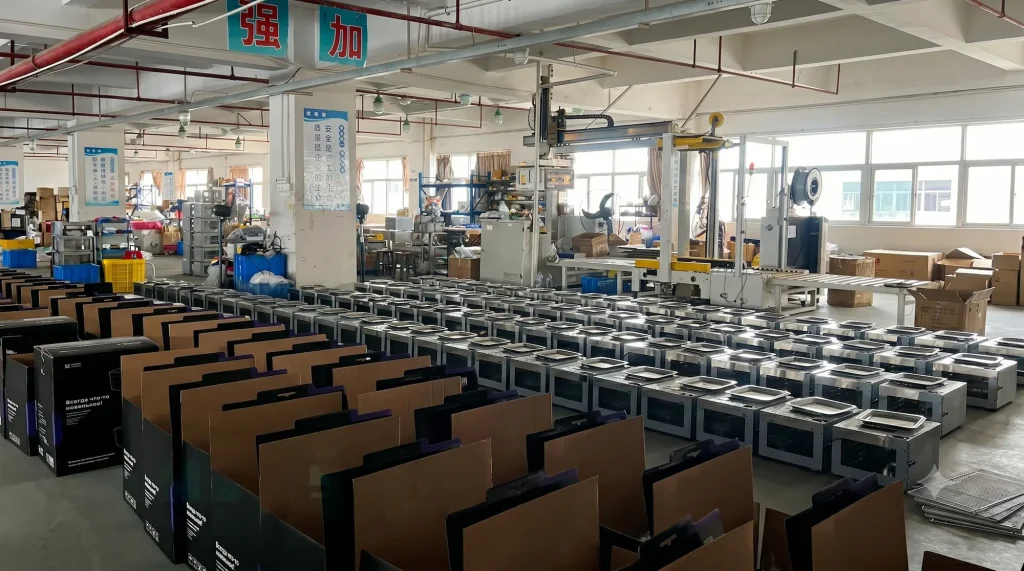
Ask the supplier about its production area, monthly output, main production lines, and how it manages seasonal orders. UCK operates a modern 6,000-square-meter factory and has built a supply chain covering R&D, design, production, and sales. The company information states monthly output around 30,000 units and maximum annual capacity up to 400,000 units, depending on product mix and order planning.
For B2B purchasing, these numbers matter because food dehydrators are often sold through seasonal channels. Buyers may need large shipments before harvest season, holiday sales, pet snack promotions, or private label product launches.
Ask these questions before placing an OEM order:
- What is the normal production lead time?
- Can the factory support repeat orders after the first shipment?
- Does the factory have enough parts and packaging capacity?
- Can it handle customized plugs, labels, cartons, and manuals?
- How does it schedule production during peak season?
UCK’s company materials mention a normal delivery cycle of 25 to 30 days. This is useful for quotation planning, but buyers should still confirm the exact lead time based on model, order quantity, packaging requirements, and certification needs.
3. Review R&D Capability Before Asking for Customization
OEM and ODM projects often fail when buyers assume that every factory can customize. Changing a logo is simple. Changing a control panel, tray structure, voltage configuration, air duct, color, plug, or packaging system is a different job.
A capable manufacturer should have an engineering team that can review your market requirements and convert them into a workable product configuration. UCK’s company information mentions a 12-person R&D team with experience in product development, testing, and optimization.
When discussing customization, be specific. Instead of asking, “Can you do OEM?” prepare a short brief:
- Target market and voltage
- Required plug type
- Tray quantity and tray material
- Capacity range
- Temperature range
- Timer range
- Noise requirement
- Logo and packaging needs
- Certification or documentation requirements
For food dehydrators, practical customization often includes 110V to 240V voltage support, regional plug options, private label control panels, packaging artwork, instruction manuals, tray count, color, and model configuration.
4. Pay Attention to Materials and Food Contact Parts
Food dehydrators are not decorative appliances. Trays, racks, doors, heating zones, and internal airflow areas are used close to food for long periods. That makes material choice important.
For many UCK dehydrator models, the selling-points document highlights food-grade 304 stainless steel trays, stainless steel body construction, corrosion resistance, and safer food contact compared with ordinary stainless steel or galvanized sheet structures.
When evaluating a supplier, ask which parts are food contact parts and what material is used. For commercial buyers, also ask how easy the trays are to remove and clean. In restaurants, farms, and food workshops, cleaning time is part of the real operating cost.
Useful checks include:
- Are the trays stainless steel or plastic?
- Are tray edges smooth enough for repeated handling?
- Can the tray support heavier food such as meat, fish, or thick fruit slices?
- Is the cabinet easy to wipe down?
- Does the door seal reduce heat loss?
- Are spare trays available for replacement orders?
A better manufacturer will not only tell you the material. It will explain why the material matters for safety, cleaning, durability, and long-term use.
5. Confirm Temperature, Timer, and Safety Control
Drying quality depends on control. A product may look professional from the outside, but if temperature fluctuates too much or airflow is uneven, the final food may dry inconsistently.
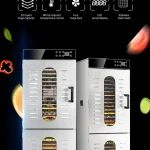
UCK’s food dehydrator selling points include a 30 to 90 degrees Celsius adjustable temperature range for many models, microcomputer temperature control, timer settings from 30 minutes to 24 hours, automatic shutdown after the set time, and over-temperature protection.
For B2B buyers, these features are more than marketing points. They reduce labor, help keep batch results stable, and make the product easier to explain to end customers.
Ask the manufacturer:
- What is the temperature range?
- How long can the timer run?
- Is there automatic shutdown?
- Does the machine include over-temperature protection?
- Does the product use a touch panel or mechanical control?
- How does the machine improve drying uniformity?
If your market includes humid regions, ask about PCBA sealing and moisture protection. UCK’s materials mention improved circuit-board sealing for high-humidity regions such as Southeast Asia, which can be important for export buyers.
6. Ask for Certification Support Early
Certifications should not be discussed at the end of a project. They can affect product configuration, components, labeling, manuals, and market access.
UCK’s company profile materials mention certifications and standards including CB, FCC, RoHS, FDA, CE, PSE, ETL, UKCA, and ISO9001 quality management. Buyers should confirm which specific model has which certificate, because certification often applies to certain product models, not every item in a catalog.
Before ordering, ask:
- Which certificates are available for the exact model?
- Can the certificate holder and model number be matched to your order?
- Are test reports available?
- Does the packaging need special marks?
- Does your target country require additional documentation?
For private label projects, also confirm whether the certification can support your branding plan or whether additional testing is needed.
7. Evaluate Packaging and Supply Chain Control
Packaging is easy to overlook until a shipment arrives damaged. For food dehydrators, cabinet shape, glass doors, stainless steel trays, and control panels need proper foam, carton strength, and handling marks.
UCK’s company information states that the company has developed upstream and downstream support, including hardware processing and carton production. This matters because packaging and metal parts are two areas where cost, consistency, and delivery schedules can easily affect the finished product.
When comparing suppliers, request:
- Drop-test or packaging photos
- Carton dimensions
- Gross weight and net weight
- Loading quantity
- Spare parts policy
- Label and manual customization options
For distributors, carton quality is not just logistics. It affects shelf presentation, warehouse handling, and customer confidence.
8. Choose a Factory That Can Support Repeat Business
The first order tests the product. The second and third orders test the supplier.
A strong food dehydrator manufacturer should offer stable communication, clear specifications, quality inspection, replacement parts, packaging records, and support for product updates. UCK positions itself as a manufacturer integrating R&D, design, production, sales, OEM/ODM, and export service, which is the kind of structure B2B buyers should look for.
Before placing a larger order, start with a sample or trial order if possible. Test the product under your real market conditions. Check drying results, noise, control panel usability, tray handling, packaging, and customer-facing materials.
FAQ
Are you a manufacturer or a trading company?
UCK is a food dehydrator manufacturer with its own R&D, production, quality inspection, sales, and supply chain support. The company supports OEM and ODM projects for distributors, importers, and private label buyers.
Can I customize the food dehydrator for my market?
Yes. Customization can include logo, control panel, color, packaging, voltage, plug, manual, and model configuration. The exact options depend on the selected model and order quantity.
What certifications can UCK support?
UCK company materials mention CB, FCC, RoHS, FDA, CE, PSE, ETL, UKCA, and ISO9001. Buyers should confirm certificate availability for the exact product model before ordering.
What is the normal delivery time?
Company information indicates a typical delivery cycle of 15 to 30 days. The final lead time depends on model, quantity, packaging, customization, and production schedule.